
MARKET OVERVIEW
Consistent with seasonal trends, Q1 Commercial Real Estate (CRE) activity moderated following the typical year-end surge of Q4 closings. However, the underlying data suggests a resilient start to the year; transaction volume across the four major asset classes is projected to exceed $66 billion. This represents a marginal improvement over the Q1 2025 baseline, according to an analysis of CoStar data.
The Office and Industrial sectors emerged as the primary pace leaders during Q1 2026, even as the broader market navigated familiar headwinds. Specifically, the re-emergence of tariff policy uncertainty and a "wait-and-watch" stance from the Federal Reserve have tempered immediate expectations, with some analysts forecasting just one more rate cut later this year.
Despite these macroeconomic pressures, sentiment1 among recently polled Avison Young CRE professionals remains cautiously optimistic. This confidence is largely underpinned by improving liquidity and access to capital, highlighted by a significant 27% year-over-year increase in commercial mortgage originations.
In January, the CoStar Commercial Repeat-Sale Indices (CCRSI) recorded a slight 0.4% dip, after seven months of upward momentum. This momentum pushed annual prices positive for the first time since last March, up 0.8% for the 12 months ending in January. This follows a 2025 calendar year characterized by a glacial pace of price erosion, which totaled only 0.4%. While cap rates remained stable relative to year-end 2025 levels, delinquency rates for both CMBS2 and bank lending3 trended upward, reflecting ongoing credit pressure.
However, broader market indicators suggest a transition is underway. The Mortgage Bankers Association (MBA) recently noted that the industry is beginning to “move past the peak of the maturity wave,” a shift driven by a combination of strategic refinancings and a pickup in acquisition activity. Despite these shifting dynamics, the volume of distressed transactions remained unremarkable, suggesting that many owners are successfully navigating the current environment without being forced into liquidation.
The Industrial and Multifamily sectors continued the rebalancing process, with vacancy rates approaching cyclical highs in January–7.5% for Industrial and 8.6% for Multifamily—based on CoStar data. Both sectors experienced cooling rent growth4 as they absorbed the residual effects of prior construction booms and elevated supply levels.
Looking ahead, the outlook diverges modestly between the two. Industrial development is expected to show relative resilience, particularly in manufacturing-related facilities supported by favorable tax policies and at least $850 million in new lending5 from the federal Office of Strategic Capital (OSC). Multifamily demand is anticipated to re-emerge as new supply is digested; however, improvements in fundamentals are likely to be gradual. As absorption strengthens and deliveries moderate, the sector should transition toward more stable occupancy and rent growth trends over time.
The Office sector showed clear signs of stabilization as the year concluded. After peaking in mid-2025, vacancy rates moderated 14% in December, as reflected in CoStar data. This recovery was supported by a rebound in net absorption4 and a broadening of demand beyond Class A assets, as tenants reacted to a dwindling pipeline of new deliveries. However, this stability came at a cost, as landlords increasingly prioritized tenant retention over aggressive rent growth4.
In contrast, the Retail sector emerged as a top performer following a moderately successful holiday season, boasting the highest rent growth and lowest vacancy rates4 among the major asset classes. This strength was further evidenced by a decline in move-out rates at year-end. Looking ahead, consumer spending is expected to be bolstered by larger average tax refunds, which may help offset concerns regarding the labor market.
A slowdown – and in some markets, an outright decline – in new deliveries has helped stabilize fundamentals across major property types. This dynamic may persist, particularly as data center development absorbs a growing share of construction capacity, capital, and power availability – potentially crowding out other forms of new supply.
Data center inventory6 expanded sharply in 2025, increasing 33%, and could double7 again this year, according to Bisnow. It’s also worth noting that growth is no longer confined to traditional hub markets; new development activity is spreading into a broader set of geographies.
A DEEPER LOOK: RETAIL NEIGHBORHOOD CENTERS
Neighborhood Centers have demonstrated notable adaptability as consumer preferences continue to evolve. Many properties are increasingly anchored by necessity-and value-oriented tenants that tend to perform well in tighter economic conditions – particularly supermarkets and discount stores. Investors have taken notice. According to CoStar data, Neighborhood Center sales volume rose 24.9% in Q4 2025, outpacing every other major retail subtype (with the exception of malls, which represented just 1.7% of total deals) and exceeding the 15.7% gain of the combined four major sectors.
As illustrated in the charts below, investor interest increased meaningfully in both the West and Southwest, with sales volumes rising 51% and 44% respectively. In the West, the majority of available inventory was concentrated in California, particularly in Los Angeles and Riverside counties. However, the region continues to see limited new construction, which may constrain transaction velocity going forward. By contrast, the Southwest presents a more balanced alignment between rising transaction activity and available supply. Transaction activity has been broader based across the region, with opportunities spanning Phoenix and Albuquerque, as well as the suburban markets surrounding Austin, Dallas, and Houston.
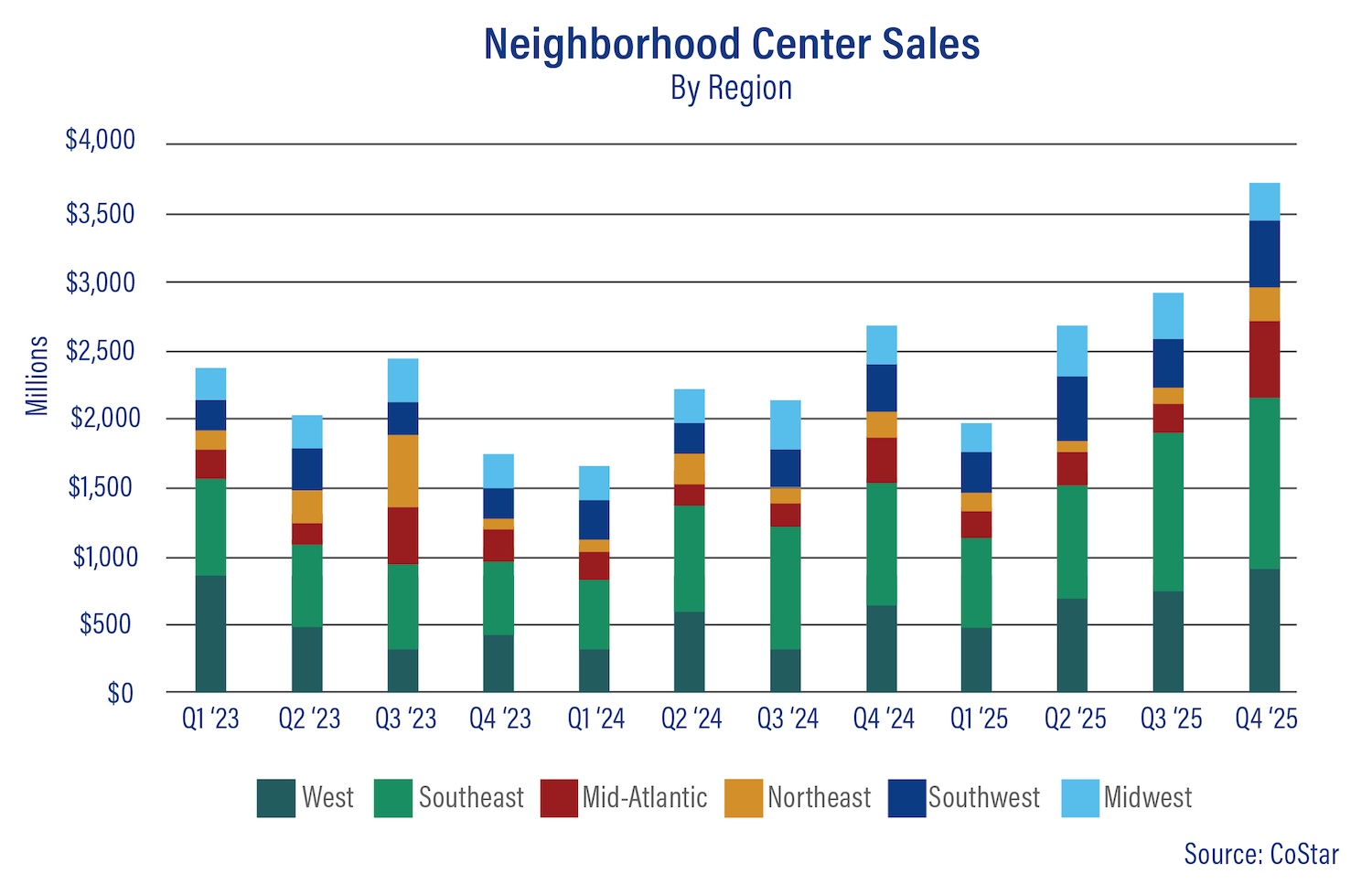
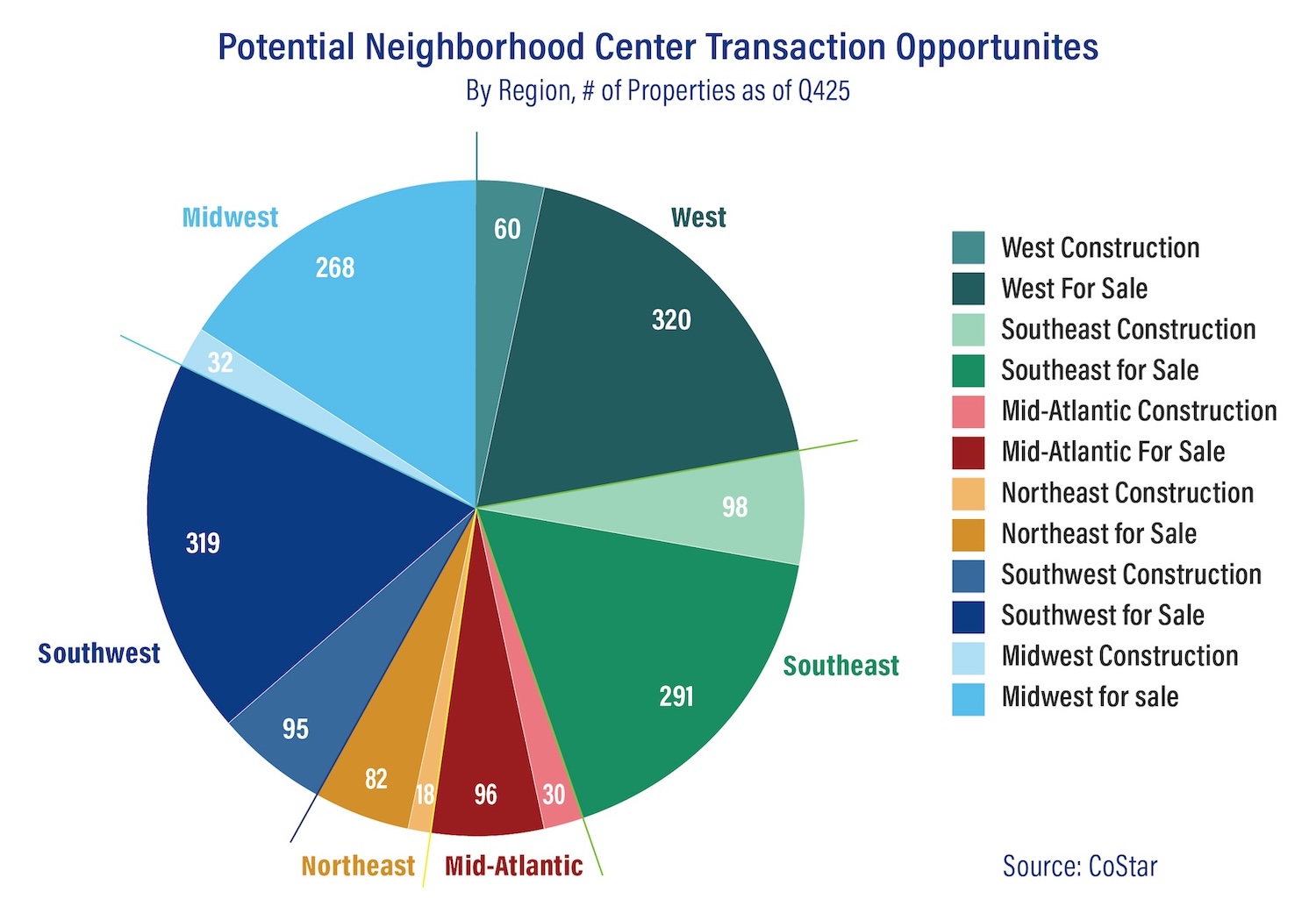
The Southeast outpaced all other regions in overall scale, with transaction dollar volume increasing 26% in 2025. Several markets stand out where investor demand aligns with anticipated availability, including Charlotte, North Carolina and Jacksonville, Florida – both of which continue to benefit from favorable demographic and economic trends.
The Mid-Atlantic also warrants attention. Transaction activity in the region rose 34% last year, and the balance between investor interest and available inventory is comparable to that of the Southeast. Philadelphia, Pennsylvania; the suburbs of Washington, D.C., and Richmond, Virginia attracted meaningful investor appetite in 2025 and continue to offer a pipeline of actionable opportunities.
Investor sentiment toward the Midwest and Northeast remained muted throughout 2025, as both regions grappled with a disproportionate volume of available inventory. This supply overhang, coupled with softer demand, resulted in a significant pullback in new construction activity across these markets. However, Omaha, Nebraska emerged as a notable exception to this regional trend. The market stood out as a pocket of resilience, attracting sustained investor interest while simultaneously supporting new development projects – a rare combination in an otherwise cautious geographic landscape.
WHAT'S NEXT?
Find out how the first quarter of 2026 ends and what’s on the horizon for the spring selling season in Old Republic Title’s next Economic Update.
1 Avison Young, "2026 Annual Outlook." Reprinted with permission March 2026.
2 CRED iQ. “Delinquency Report December 2025.” Reprinted with permission March 2026.
3 Board of Governors of the Federal Reserve System (US), Delinquency Rate on Commercial Real Estate Loans (Excluding Farmland), Booked in Domestic Offices, All Commercial Banks [DRCRELEXFACBS], retrieved from FRED, Federal Reserve Bank of St. Louis; https://fred.stlouisfed.org/series/DRCRELEXFACBS, February 27, 2026.
4 Copyright © 2025 “January 2026 Commercial Real Estate Market Insights.” NATIONAL ASSOCIATION OF REALTORS®. All rights reserved. Reprinted with permission. March 2026.
5 Avison Young, “U.S. Industrial market report Q4 2025.” Reprinted with permission March 2026.
6 Avison Young, “Q4 2025 U.S. data center market overview.” Reprinted with permission March 2026.
7 Bisnow, “64% of New Data Centers Are Being Built Far From Silicon Valley, Virginia.” Reprinted with permission March 2026.