After an unexpectedly sparkling Gross Domestic Product performance in Q3, economic prospects in Q4 were tarnished by the longest government shutdown in U.S. history, dogged inflation and a worsening job market. The Federal Reserve (the Fed) responded with two more rate cuts and clarity on its path and employment priority. Falling mortgage rates and home prices warmed some home purchasers’ hearts, although economic concerns still fostered hesitancy in sellers, buyers and builders. Commercial Real Estate (CRE) transactions were cooled somewhat by the government shutdown. But 2025 was the second year with transactions over $300B, confirming the start of a new CRE cycle.
Residential Real Estate
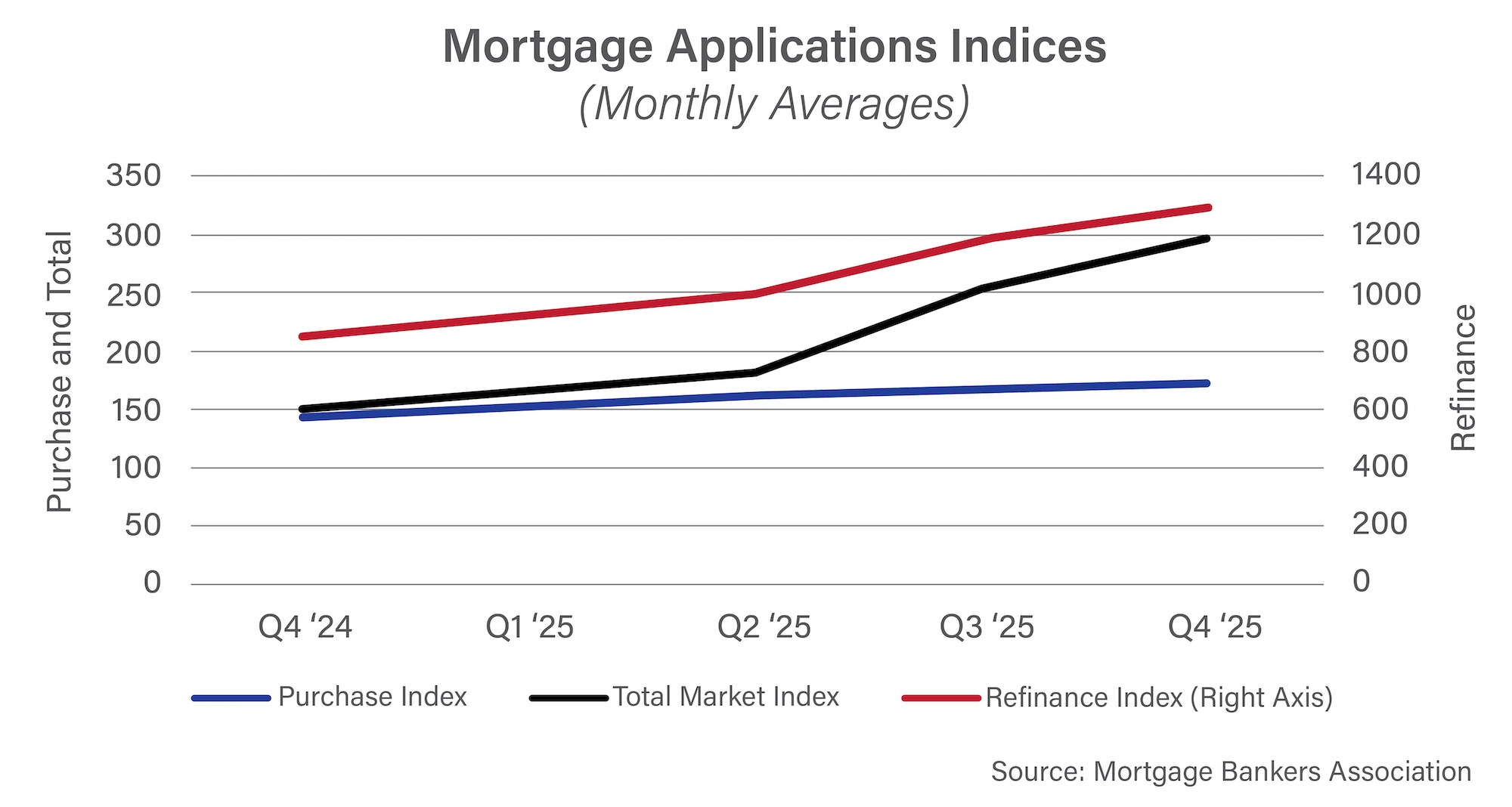
Thanks to the 30-Year-Fixed Mortgage Rate dipping a full 50 basis points (bps) over the last six months, momentum in Q4 boosted the Total Homes Sales 2025 figure to exceed the underwhelming numbers of 2024. New and Existing Sales both jumped over 6.5% quarter-to-quarter. The market was more balanced and more affordable. Active Listings1 advanced over 12% in November compared to last year and both New and Existing Median Home Prices drifted lower.
However, market activity had a frosty feel to it. People had job insecurity and general price-level woes at the forefront of their minds. Buyers, gleefully facing less competition and stronger negotiating power, took their time with offers. Sellers delisted if the price wasn’t right. Regional inventory1 and pricing notably diverged this year; builders, particularly in the overbuilt Southwest and West, leaned heavily on concessions. Interest rate moderation unthawed builder sentiment2 a bit, but they still became more Scroogelike with Housing Starts.
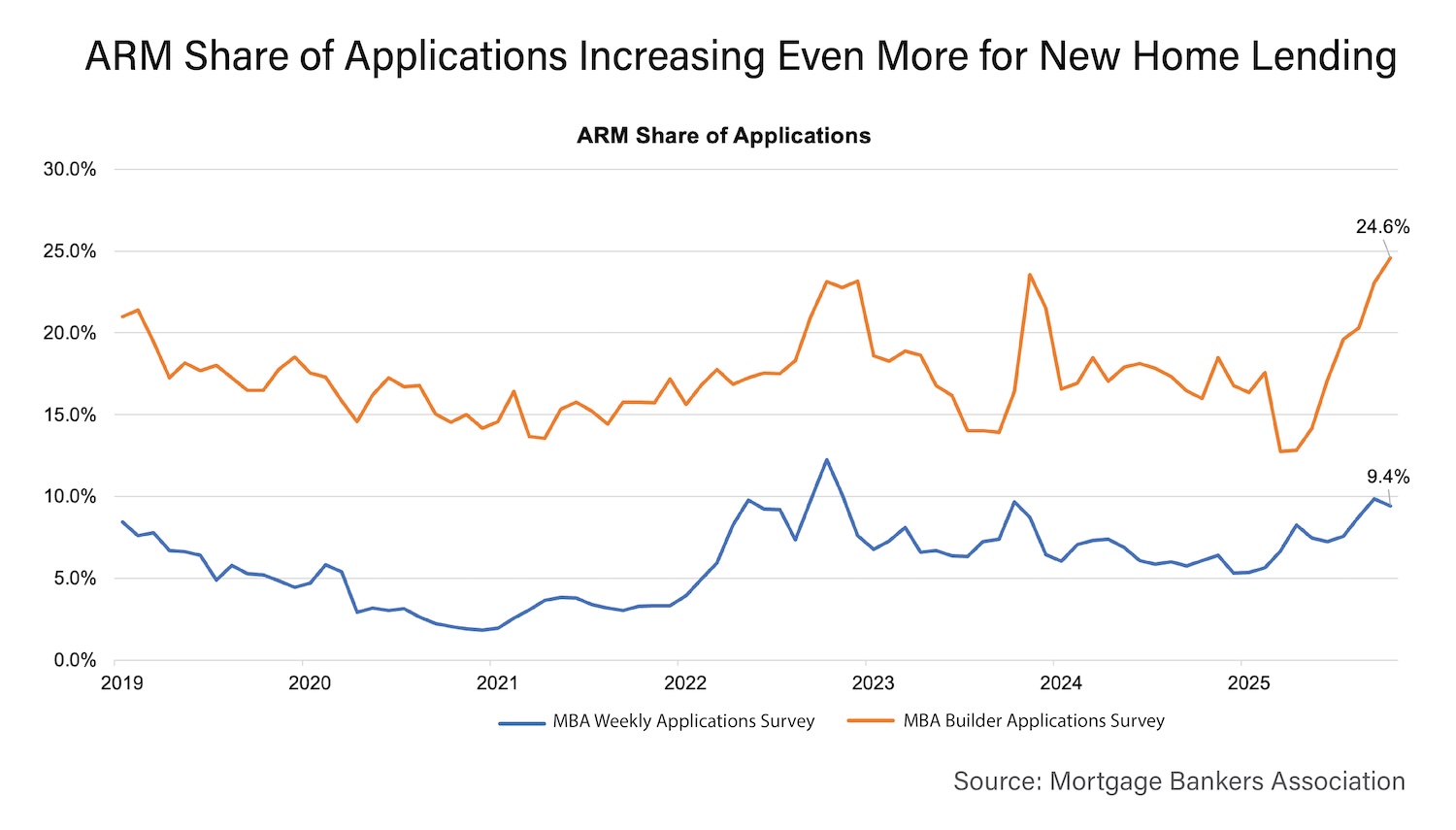
For motivated market participants, the lower interest rates were a gift. Adjustable Rate Mortgages (ARMs), which typically have initial rates at least 25 to 50 bps lower than their 30 year-fixed counterpart, fell past the psychologically important 6% bar in September and hovered in the mid-5% range through year end. Consequently, the preference for ARMs increased, particularly for new home purchases; they were 25% of originations in October, up from 16% last year, according to the Mortgage Bankers Association (MBA). Refinancings (refis) were 45% of originations in Q4, as borrowers from just a few years ago increasingly grabbed the opportunity to lower their payments. Some of these refis were ARMs, allowing relief for a slice of those “locked in” 20%3 of borrowers with rates above 6%.
Commercial Real Estate
At almost $88B, Q4 CRE transactions for the four major asset groups settled slightly below the previous quarter. But 2025’s volume surpassed 2024’s at approximately $323B, according to CoStar data.
The quarter’s performance would have shined brighter, had the long government shutdown not dimmed some deal prospects. The Office sector, once again, was the bright star. Office property prices may have bottomed out, possibly motivating buyers to the table ahead of appreciation. Institutional investors warmed back to the market, with CoStar reports reflecting portfolio diversification in high-end industrial properties, data centers, office buildings and retail space.
Industry-wide prices rose for the fifth month in November and cap rates were steady. Delinquencies decreased in Q3 for all sectors but Multifamily. Distressed transactions remained low as lenders actively refinanced maturing loans as part of the annual 36% increase in originations in Q3 reported by the MBA.
CRE fundamentals were firmed up by the fall-off in construction due to rising and uncertain tariff-related building costs. Deliveries of Office, Retail and Industrial properties in November were at the lowest level in over a decade. Multifamily4 new construction plunged 47% annually in Q3. Both Office and Multifamily vacancies reflected this situation and plateaued in Q4, although rents1 remained subdued. Retail weathered the year’s earlier closures; CoStar reported that Q3 saw the highest pace of move-ins since 2022. Vacancy and rental rates5 remained the most attractive of the major sectors. Industrial seemed an outlier. Rental rate2 growth weakened further and vacancies ticked up, even as a lower but still significant amount of new space arrived. However, building shifted from speculative properties to build-to-suit, indicative of dedicated demand, persistent e-commerce needs and a glimmer of a manufacturing rebound. Data Center expansion, which also feeds Industrial demand, continued its meteoric rise. In Q3, their vacancy rates sat below 1% in 10 major markets.
A Glance Forward
GDP is expected to rebound next quarter, propelled by a catchup in government spending and healthy consumer expenditures. With minimal movement in both inflation and unemployment forecasted, the Fed in Q1 may stay put on rates and continue to be “well positioned to wait and see how the economy evolves.”
The residential market is expected to have a slow start. Mortgage rates likely will be frozen in place by the persistent risk of inflation and the unaddressed government deficit. Builders may only marginally add to housing stock as they work through current inventory. But falling median home prices should eventually bring Total Home Sales growth to 6.5% in 2026.
CRE professionals believe the market will be more hospitable in 2026. Thanks to what Avison Young6 called the “directional conviction” of the Fed’s third rate cut in December, financial cost uncertainty is fading. While investors will welcome the market’s continuing stabilization, it may mean the most for current borrowers. Firmed up valuations and supportive financial conditions will make the “wall of maturities” less imposing. The MBA foresees enduring confidence by lenders; they believe commercial originations will climb 24% next year.
Overall, there is hope that Q1 2026 will be like the morning of a perfect ski day: sunny and chilly at first, but with the promise of warmer runs to come.
Sources:
1 Realtor.com, “November 2025 Monthly Housing Market Trends Report.” December 8, 2025. http://realtor.com/research/november-2025-data/
2 National Association of Home Builders, “Builder Sentiment Inches Higher but Ends the Year in Negative Territory.” December 15, 2025, https://www.nahb.org/news-and-economics/press-releases/2025/12/builder-sentiment-inches-higher-but-ends-the-year-in-negative-territory
3 Realtor.com, “81% of Outstanding Mortgage Debt Has a Sub-6% Rate.” August 13, 2025, https://www.realtor.com/research/2025-q1-outstanding-mortgage-data/
4 Avison Young, “Q3 2025 U.S. multifamily market overview.” Reprinted with permission January 2026.
5 Copyright ©2025 “November 2025 Commercial Real Estate Market Insights.” NATIONAL ASSOCIATION OF REALTORS®. All rights reserved. Reprinted with permission January 2026. https://www.nar.realtor/commercial-real-estate-market-insights/november-2025-commercial-real-estate-market-insights
6 Avison Young, “12 CRE Takes About The Fed's Last Rate Cut of 2025.” Reprinted with permission January 2026.